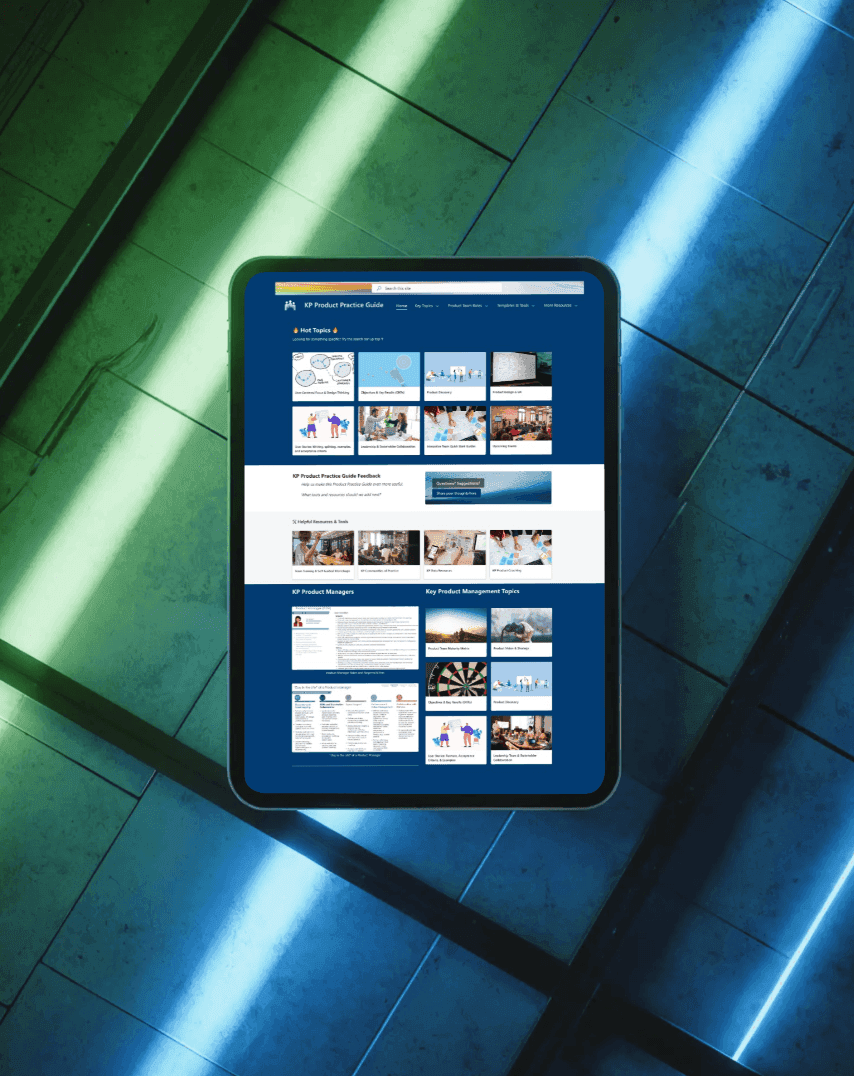
Building the Kaiser Permanente Product Practice Guide
Principal Product Coach·Kaiser Permanente IT Teams·2023 - 2024
HealthcareDelivery TransformationProduct Strategy
The Product Practice Guide changed how our teams talk about product. It's practical, trustworthy, and rooted in how Kaiser actually works - not just best practices from elsewhere.
The impact
Reached ~20,000 KP IT staff. 1,150+ learning-event attendees. 40+ resources published. Coached 70+ teams across 9 portfolios. Board recognized the work as a 2023 transformation milestone.
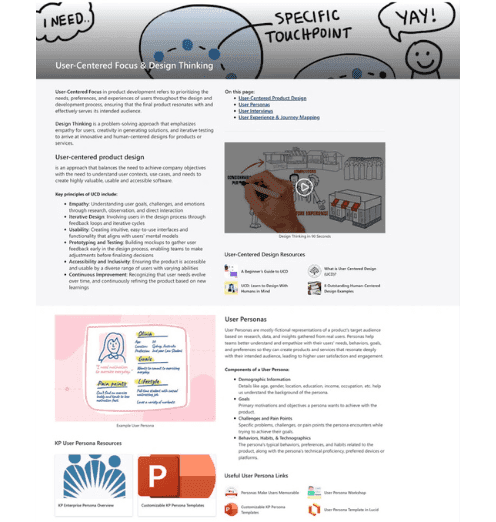
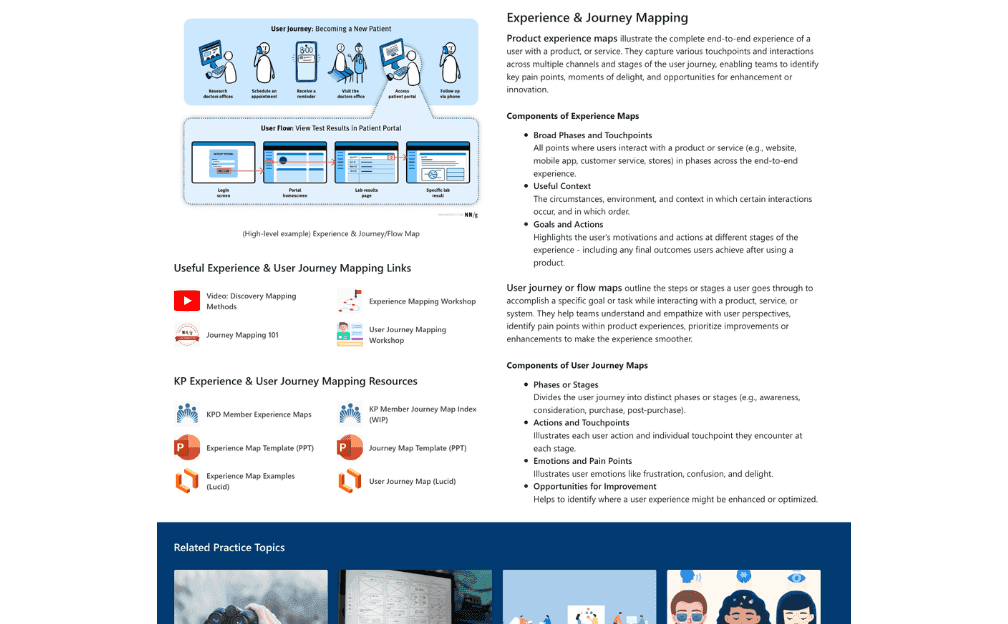
I designed and launched the Kaiser Permanente Product Practice Guide, a Kaiser-specific learning hub that became the go-to resource for product teams across KP Digital and KPIT. It anchors training sessions, links into KP Learn, and is the foundation for Kaiser's ongoing product enablement. The reach numbers matter, but the one I designed for is invisible in a slide: whether the guide keeps improving after I leave.
The gap was usability, not coverage
When I came in, Kaiser's teams were expected to run a modern product model, but there was nowhere to learn what that meant at Kaiser. The instinct in a place this size is to write more documentation. That instinct is the trap. Materials already existed, scattered across SharePoint folders, outdated PDFs, and individual coach decks, and none of it changed how anyone worked. More content would have meant more to ignore.
So I audited what existed and mapped it against what teams were actually struggling with: outcome-based OKRs, discovery patterns, cross-functional rituals, backlog health, coaching technique. The real gap was usability. A theoretical framework does nothing for a product manager who has 60 minutes and a calibration session to run. The job was content that could flex from a new hire's first week to a seasoned lead's recalibration, in Kaiser's own language.
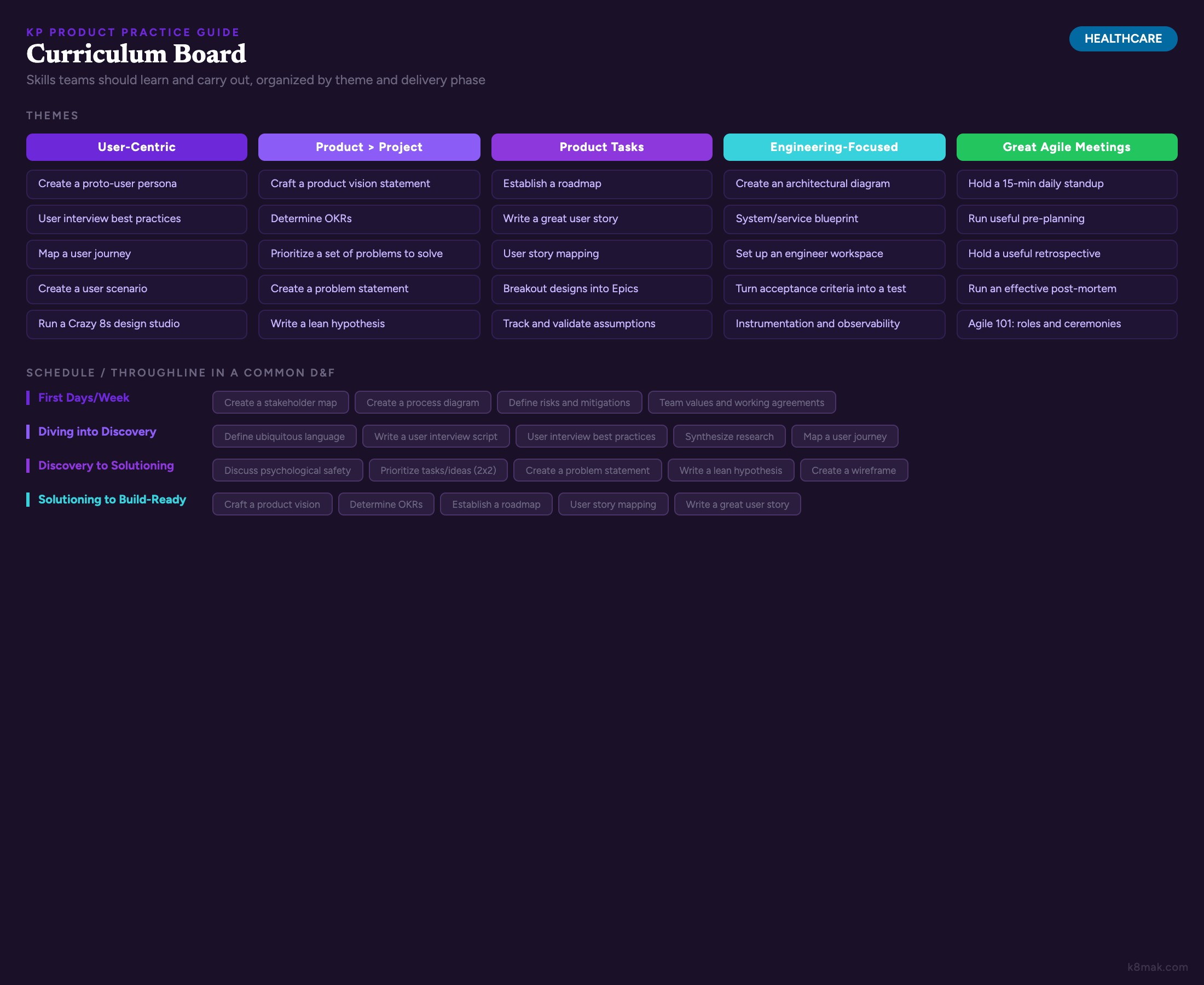
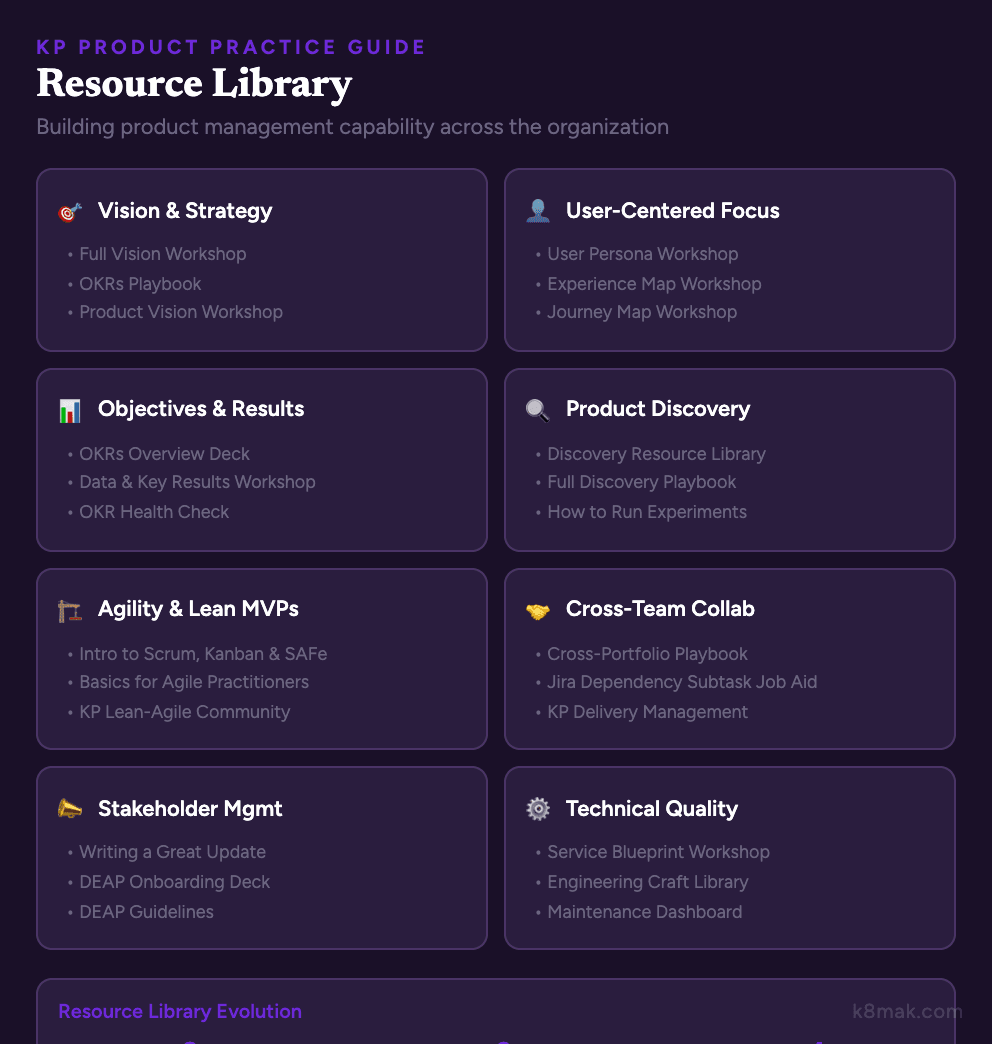
The Quick Start Guides did that work: each carried prompts, diagrams, reflection activities, and facilitation tips so a coach could pick one up and run it without rewriting. To stop the portfolio from shipping outputs over outcomes, I facilitated 15 executive workshops connecting the L1-L4 OKR cascade to real roadmaps, so an enterprise metric could be traced down to what a squad actually did this quarter. The board recognized the work as a 2023 transformation milestone.
I built the thing to outlive me
The highest-leverage piece is the least glamorous one. A learning hub that depends on its author is a liability the moment that author leaves. So I built the SharePoint architecture for tagging, search, and versioning, defined the content RACI, set an intake process and review cadence, and coached SMEs on how to write updates people would actually use. That is the difference between a guide that decays into another dead PDF folder and one that compounds.
What this built
- A trusted, scalable learning system. 40+ resources, 12+ workshop guides, and a SharePoint architecture that teams across KP Digital and KPIT rely on for onboarding, calibration, and coaching.
- A shared standard for what "good" looks like. Checklists, examples, and guided activities in Kaiser's own context, in place of abstract frameworks teams could not use.
- Sustainable content infrastructure. Content RACI, intake, and review cadence keep the guide improving without external support, which is the only way something like this lasts.
Related case studies
Delivery Transformation: Reduced Cycle Times
Principal Product Coach · 2023 - 2024
Improved delivery speed and team clarity by redefining rituals, coaching, and product operations across Kaiser IT.
Launching FLUXX: An AI-Powered Menopause Platform
Director of Product (Fractional) · 2024-2025
Fractional Head of Product for FLUXX, a clinician-led menopause platform. Took it from clinical research with no product infrastructure to a launched MVP in under six months, with AI phase scoring validated by real clinicians and a re-engagement model that beat healthtech norms.
Designing a Wellness MVP for Biomarker-Driven Preventative Care
Director of Product (Fractional) · 2024 - 2025
Served as Fractional Director of Product to lead Sperity Health from vaporware to a functioning, HIPAA-compliant MVP. Built the roadmap, treatment logic, product team, and app experience for members to understand diagnostics, track progress, and access elite care.
Want to bring this kind of thinking to your team?
I help teams ship products with clarity, speed, and care.
Or trace the through-line: the full 14-year career timeline →